Checkpoints
TROVE provides an extended set of the so-called ‘checkpoints’, with the main functionality to provide the capability of restarting the calculations at any critical point. The checkpoints are TROVE files with extension .chk that contain the necessary information for the restart. Some of the files are in the ASCII format (i.e. ‘formated’), some are written in as machine readable, i.e ‘unformatted’, some - as direct access files. For instance, the transition between steps 1,2,3, … is driven by the checkpoint functionality. Moreover, since step 1 contains a number of critical sub-steps, TROVE checkpoints those sub-steps as well.
Apart from the restarting functionality, the .chk files are also used to store the eigenvectors (i.e. eigencoefficients). Although these objects are formally a the end result of the calculations, in same cases they provide support for some intermediate steps. For example, step 2 (transformation of matrix elements to the  representation) used the eigenfunctions of the solution obtained at step 1 to create a basis set for step 3 (production of eigenfunctions for
  ).
).
The checkpoints control section is CHECK_POINT, e.g.:
CHECK_POINT
 ascii
 kinetic     read
 potential   read
 external    none
 basis_set   save
 contract    save
 matelem     save    split
 extmatelem  none    split
 eigenfunc   save
END
with the main control keywords save, read and none and the additional keywords append, stitch, split etc. The functional checkpoint keywords include
kineticpotentialexternalbasis_setcontractmatelemextmatelemeigenfuncfit_poten
The order of these lines is unimportant. The CHECK_POINT section can appear anywhere in the input file.
List of checkpoints
kinetic.chk (
kinetic) contains the expansion coefficients of the KEO as controlled by theKinorderkeyword.The KEO is the first to be constructed and saved if
kineticis set tosaveand can be then used at any stage by switching toread. One opt out from saving the KEO (or any other checkpoint) by setting it tonone.potential.chk (
potential) is the second object created in TROVE as part of step 1.It contains expansion coefficient of PEF in terms of the TROVE vibrational coordinates. It can be saved, if generated from scratched and then read after a TROVE restart.
external.chk (
external) is used to store expansion coefficients of any other objects apart from KEO and PEF,dipole moment, polarizability, spin-rotation, a correction to the PEF used for the refinement of the PEF etc, which are called
ExternalorDipoleThe same functionality as above is applied to the External field.hamiltoian.chk:
This file contains the definition of the linearised coordinates (A and B matrices, see the TROVE paper [TROVE]), i.e. for
COORDS linearin the case of the linearised coordinate. It is saved and read as part of thekineticswitch. hamiltoian.chk is not produced for the curvilinear coordinate typeCOORDS local.kinetic.chk, potential.chk and external.chk have the ASCII format and can be used to plot the corresponding fields or their individual components.
numerov_bset.chk and prim_bset.chk (
basis_set).These two unformatted files containing information on the 1D primitive basis sets and are produced after the objects described above. The same rules are applied for saving, reading or doing nothing (
none).contr_descr.chk, contr_quanta.chk, contr_vectors.chk (
contract) are three files to store the information on the symmetry adapted basis functions for individual basis sub-sets.contr_vectors.chk is an unformatted file containing eigne-coefficients.
contr_quanta.chk is a formatted (ASCII) file with the information on the basis set bookkeeping - mapping of the multimode quantum numbers into a 1D array.
contr_descr.chk is a formatted file containing descriptions of the basis sets:
individual energies of the basis functions from different sub-sets together with their classifications, symmetries, TROVE quantum number, IDs, largest expansion coefficients used in their assignment as well as a placeholder for the spectroscopic quantum numbers. This file can be edited in order to include these spectroscopic quantum numbers.
contr_matelem.chk (
matelem) contains vibrational matrix elements of the different pars of the Hamiltonian operator (KEO and PEF)on the basis set produced at the
contractstep, i.e. contracted symmetry adapted basis functions.matelem1.chk, matelem2.chk … matelem12.chk represent a
splitversion of contr_matelem.chk, which contain the rotational and Coriolis parts of the KEO,while contr_matelem.chk contains the matrix elements of the pure vibrational part of the Hamiltonian operator, i.e. vibrational KEO + PEF. The
splitoption allows one to compute all these 13 parts ofmatelemsseparately, which is especially useful for larger molecules. Historically, thematelemstep the main bottleneck in the TROVE pipeline in the case of large molecules and thesplitfeature allows one to at least partly mitigate this issue. An example of thesplitoption isTo process all 13 parts of the Hamiltonian:
contract save split
To process individual parts of the Hamiltonian (from 0 to 6):
contract  save split 0 6

here 0 stands for the pure vibrational part of the Hamiltonian operator.
To process a single part of the Hamiltonian (from 11 to 11):
contract save split 11 11
contr_extfield.chk
extmatelemcontains all (vibrational) matrix elements of the external field.extmatelemstep is not a compulsory step in the TROVE pipeline. It is invoked when keyword it is set tosave.extmatelem1.chk, extmatelem2.chk, extmatelem3.chk …. are the
splitanalogy of contr_extfield.chk,where different components are written into separate extmatelem chk-files.
Examples of the split option include
extmatelem save split 1 1
extmatelem save split
eigen_descr*chk,eigen_vector*chkandeigen_quant*chk(eigenfunc) contain the eigen-coefficients and their descriptions.eigen_descr
 _
_ .chk contain the eigenvalues (energy term values in cm-1):
state IDs, symmetries, TROVE quantum numbers, largest coefficients as well as a placeholder for the spectroscopic quantum numbers. These files formatted (ASCII) and can be used for the analysis or postprocessing (e.g. construction of line lists). Here
is the rotational angular momentum and is the symmetry (irrep), i.e. there is a description for each J/symmetry. For example, eigen_descr0_2.chk is a checkpoint file with the description of the eigenstates and their eigenvalues for and  .
.eigen_vectors
_.chk contain the eigencoefficients written in direct unformatted form.For each
eigen_descr*chkthere is an eigen_vector*chk file.eigen_quant.chkcontain the bookkeeping information for the basis sets used:the mapping between the multidimensional, multimode description of the product-form basis functions to a 1D basis set index.
j0_matelem.chk(matelem) is the representation of contr_matelem.chk generated at step 2.In order to switch to step 2 and thus distinguish from step 1, the following changes to the step 1 input file should be made:
In the
contractedsection, setmodel J=0
In the
check_pointsection set.... contract save matelem convert eigenfunc read ....
j0_matelem1.chk, j0_matelem2.chk … j0_matelem12.chk are the
representation of matelem1.chk, matelem2.chk … matelem12.chk, respectively, in the splitform.These files are generated as part of step 2, which can be accomplished by simply setting
step 2in theControlsection:control step 2 end
Alternatively, the changes described above to produce j0_matelem.chk should be introduced, with only one difference of including the
splitsub-option:.... contract save matelem convert split eigenfunc read ....
In the
representation, the zero-term, pure vibrational j0_matelem0.chk is not produced. This is because this part is diagonal on the basis, with the corresponding energies on the diagonal.fitpot_ma
__:math:i.chk (fit_poten) are checkpoint files to store matrix elements of the fitting part of the potential, with representing the vibrational contribution from a specific potential parameter to be refined.
To produce and store the fitpot*.chk checkpoints, the following line should be added to the
check_pointsection:..... fit_poten save split .....
and to use them
.....
fit_poten  read  split
.....
Similar to the usage of other
splitobjects, it is possible to request only specific terms in the potential, e.g..... fit_poten save split 32 45 ....
will compute the
fit_potenmatrix elements for .
.The matrix elements in fitpot*.chk are used for the refinement of the PEF, which is controlled by the section
FITTING, see Chapter “Refine”. This section contains keywords for selection of fitpot*.chk, namelyJ-LISTandsymmetriesspecifying the values of and symmetries , respectively (both are integer) to be processed. For example:FITTING J-LIST 0 1 2 Symmetries 2 3 5 6 .....
will process the fit (
fit_potenmatrix elements) for :math`J=0,1,2` and .
.
“Fingerprints”
In order to help prevent using wrong checkpoints from different project, the descr checkpoint files (contr_descr.chk, eigen_descr*_*.chk and j0eigen_descr_*.chk) contain a “fingerprint” section at the very beginning of these formatted (ASCII) files.
Here is an example of the top part of a file eigen_descr0_3.chk from an H2S project:
Start Fingerprints
      0      3      3      4     38000.0     38000.0  <= PTorder, Nmodes, Natoms,  Npolyads, enercut
        0.01000000        0.01000000        0.01000000  <= dstep
       31.97207070        1.00782505        1.00782505  <= masses
        1.33590070        1.33590070        1.61034345  <= equilibrium
LINEAR     R-RHO      C2V(M)     XY2
BASIS:   i  type     coord_kinet coord_poten model dim species class range dvrpoints res_coeffs npoints borders periodic period
       0   <- Jrot, rotational angular momentum
         0 JKTAU      xxxxxx     xxxxxx      1000   1D    0      0    0   0     0.0          0     0.000    0.000     F  0 xxxxxx            0    F    F    T
         1 NUMEROV    LINEAR     MORSE       1000   1D    1      1    0   4     1.0        600    -0.500    1.400     F  0 NUMEROV-PO        5    F    F    T
         2 NUMEROV    LINEAR     MORSE       1000   1D    1      1    0   4     1.0        600    -0.500    1.400     F  0 NUMEROV-PO        5    F    F    T
         3 NUMEROV    LINEAR     LINEAR      1000   1D    2      2    0   4     1.0       4000     0.070    2.618     F  0 NUMEROV-PO        5    F    F    T
End Fingerprints
Start Quantum numbers and energies
       4 <== Contracted polyad number
       .........
       .........
End Quantum numbers and energies
This information is automatically degenerated using some key parameters from the input project in question, such as atomic masses, number of atoms, maximal polyad, frame, coordinates type, symmetry and a detailed description of the basis set. When such a checkpoint is read by TROVE, the fingerprint is compared against the corresponding parameters of the current project. TROVE will stop and report in case of any differences found.
These descr files end with an “End …” section, which is also used to check if all the information required has been read correctly.
Similar preventive check are used in unformatted files as well, which also start with a section “Start … “ and end with a section “End…”. These are useful to catch files that are too short or long for a given project.
Structure of the description checkpoints
contr_descr.chk
contr_descr.chk contains the energies and quantum numbers of the contracted basis states. It has the following structure
1. “Fingerprint” section, for example
Start Fingerprints
      0      3      3      4     38000.0     38000.0  <= PTorder, Nmodes, Natoms,  Npolyads, enercut
        0.01000000        0.01000000        0.01000000  <= dstep
       31.97207070        1.00782505        1.00782505  <= masses
        1.33590070        1.33590070        1.61034345  <= equilbrium
LINEAR     R-RHO      C2V(M)     XY2
BASIS:   i  type     coord_kinet coord_poten model dim species class range dvrpoints res_coeffs npoints borders periodic period
       0   <- Jrot, rotational angular momentum
         0 JKTAU      xxxxxx     xxxxxx      1000   1D    0      0    0   0     0.0          0     0.000    0.000     F  0 xxxxxx            0    F    F    T
         1 NUMEROV    LINEAR     MORSE       1000   1D    1      1    0   4     1.0        600    -0.500    1.400     F  0 NUMEROV-PO        5    F    F    T
         2 NUMEROV    LINEAR     MORSE       1000   1D    1      1    0   4     1.0        600    -0.500    1.400     F  0 NUMEROV-PO        5    F    F    T
         3 NUMEROV    LINEAR     LINEAR      1000   1D    2      2    0   4     1.0       4000     0.070    2.618     F  0 NUMEROV-PO        5    F    F    T
End Fingerprints
2. Sub-class 1
Class #       1
            15            15  <-  number of roots and dimension of basis
      1   1       1   1   3631.457962557468   0   0   0   0     0   0   0   0         0.99650855
      2   1       2   1   6237.793846833698   0   1   0   0     0   1   0   0        -0.70449312
      3   4       3   1   6920.808287732269   0   0   1   0     0   1   0   0        -0.69933488
      4   1       4   1   8799.405574657818   0   1   1   0     0   2   0   0        -0.66971512
      5   4       5   1   9424.198345933781   0   0   2   0     0   2   0   0        -0.69495690
      6   1       6   1  10131.498717237881   0   1   1   0     0   2   0   0         0.72224834
      7   1       7   1  11335.796189988198   0   2   1   0     0   3   0   0        -0.57998640
      8   4       8   1  11965.585881042278   0   0   3   0     0   3   0   0         0.62572431
2. Sub-class 2
Class #       2
             5             5  <-  number of roots and dimension of basis
     16   1       1   1   3676.343781669158   0   0   0   0     0   0   0   0         0.99914576
     17   1       2   1   4863.062238559608   0   0   0   1     0   0   0   1        -0.99741510
     18   1       3   1   6044.794034517188   0   0   0   2     0   0   0   2        -0.99558857
     19   1       4   1   7223.358797674692   0   0   0   3     0   0   0   3        -0.99426327
     20   1       5   1   8404.773619941834   0   0   0   4     0   0   0   4         0.99669840
etc. Here the TROVE sub-class stands for a symmetry independent sub-set.
The structure of the columns is as follows:
-- ------ ---- ---- ------------------ --- ---- --- ---- --- ---- --- ------ -------------
1   2       3   4          5            6   7   8   9    10   11 12   13          14
-- ------ ---- ---- ------------------ --- ---- --- ---- --- ---- --- ------ -------------
n   Sym     m   deg     Energy (cm-1)   k   v1  v2  v3    K   n1  n2  n3          C_i
-- ------ ---- ---- ------------------ --- ---- --- ---- --- ---- --- ------ -------------
1   1       1   1   3631.457962557468   0   0   0   0     0   0   0   0         0.99650855
2   1       2   1   6237.793846833698   0   1   0   0     0   1   0   0        -0.70449312
3   4       3   1   6920.808287732269   0   0   1   0     0   1   0   0        -0.69933488
4   1       4   1   8799.405574657818   0   1   1   0     0   2   0   0        -0.66971512
5   4       5   1   9424.198345933781   0   0   2   0     0   2   0   0        -0.69495690
where
Col 1:
nis the counting number of the state including degeneracies;Col 2:
Symis the irrep of this state;Col 3:
mis the running number of the energy, excluding degeneracies.Col 4:
degis a degenerate component (e.g.and

2for a 2D irrep of C3v).Col 5:
Energyterm value of a state from the given sub-class.Col 6:
kis a rotational index (typically it is zero in contr_descr.chk).Cols 7-9:
v1,v2,v3are the TROVE (local mode) vibrational quantum numbers.Col 10-13:
K, n1, n2, n3are placeholder for the user-defined quantum numbers to be propagated to the final rovibrational eigenstates.Col 14:
C_iis the corresponding largest coefficient used in the assignment.
eigen_descr*_*.chk
The eigenvector igen_descr_.chk are used to store information on the ro-vibrational states. Here and are the rotational angular momentum and the symmetry, respectively.
1. “Fingerprint” section, for example:
  Start Fingerprints
         0      3      3      4     38000.0     38000.0  <= PTorder, Nmodes, Natoms,  Npolyads, enercut
          0.01000000        0.01000000        0.01000000  <= dstep
         31.97207070        1.00782505        1.00782505  <= masses
          1.33590070        1.33590070        1.61034345  <= equilbrium
  LINEAR     R-RHO      C2V(M)     XY2
  BASIS:   i  type     coord_kinet coord_poten model dim species class range dvrpoints res_coeffs npoints borders periodic period
         0   <- Jrot, rotational angular momentum
           0 JKTAU      xxxxxx     xxxxxx      1000   1D    0      0    0   0     0.0          0     0.000    0.000     F  0 xxxxxx            0    F    F    T
           1 NUMEROV    LINEAR     MORSE       1000   1D    1      1    0   4     1.0        600    -0.500    1.400     F  0 NUMEROV-PO        5    F    F    T
           2 NUMEROV    LINEAR     MORSE       1000   1D    1      1    0   4     1.0        600    -0.500    1.400     F  0 NUMEROV-PO        5    F    F    T
           3 NUMEROV    LINEAR     LINEAR      1000   1D    2      2    0   4     1.0       4000     0.070    2.618     F  0 NUMEROV-PO        5    F    F    T
  End Fingerprints


2.  "Quantum numbers and energies" section,  Energy term values and description of the ro-vibrational states:
::

  Start Quantum numbers and energies
         4 <== Contracted polyad number
  Class #       1
              22            22  <-  number of roots and dimension of basis
         1       1       1       1   3627.658022299023       0   0   0   0       1   1   1   1       0   0   0   0         0.99958266      1      1
         2       1       2       1   4800.325667905056       0   0   0   1       2   1   1   1       0   0   0   1        -0.99819947      1      2
         3       1       3       1   5962.955540973960       0   0   0   2       3   1   1   1       0   0   0   2         0.99055229      1      3
         4       1       4       1   6236.371962631670       0   1   0   0       6   1   1   1       0   1   0   0         0.99283316      2      1
         5       1       5       1   7130.700436920808       0   0   0   3       4   1   1   1       0   0   0   3         0.97608301      1      4
         6       1       6       1   7393.117966742439       0   1   0   1       7   1   1   1       0   1   0   1         0.97535336      2      2
         ......
         ......
  End Quantum numbers and energies
The meaning of the state columns is as follows:
---- ------- ------- ------ -------------------- ----- --- --- ----- ----- --- --- ----- ----- --- --- ------ ---------------- ----- ------
1       2       3       4         5                 6   7   8  9       10   11  12 13      14   15 16   17           18         19     20
---- ------- ------- ------ -------------------- ----- --- --- ----- ----- --- --- ----- ----- --- --- ---- - ---------------- ----- ------
n      Sym     m       deg   Energy (cm-1)          k  v1  v2  v3      imax s0  s1 s2       K   n1  n2  n3           C_i       ivib1  ivib2
---- ------- ------- ------ -------------------- ----- --- --- ----- ----- --- --- ----- ----- --- --- ---- ------------------ ----- ------
1       1       1       1   3627.658022299023       0   0   0   0       1   1   1   1       0   0   0   0         0.99958266      1      1
2       1       2       1   4800.325667905056       0   0   0   1       2   1   1   1       0   0   0   1        -0.99819947      1      2
3       1       3       1   5962.955540973960       0   0   0   2       3   1   1   1       0   0   0   2         0.99055229      1      3
.................
Here
Col 1:
nis the counting number of the state including degeneracies;Col 2:
Symis the irrep of this state;Col 3:
mis the running number of the energy, excluding degeneracies.Col 4:
degis a degenerate component (e.g.
1and
2for a 2D irrep of C3v).Col 5:
Energyterm value (cm-1).Col 6:
kis a rotational index.Cols 7-9:
v1,v2,v3are the TROVE (local mode) vibrational quantum numbers.Col 10:
imaxis the position index of the largest coefficient in the basis vector.Col 11:
s0is the symmetry of the rotational basis set contribution for the term with the largest eigen-coefficient.Col 12-13:
s1ands2are symmetries of the vibrational contribution for each sub-space.Col 14-17:
K, n1, n2, n3are placeholder for the user-defined quantum numbers to be propagated to the final rovibrational eigenstates.Col 18:
C_iis the corresponding largest coefficient used in the assignment.Col 19-20:
ivib1,ivib2are counting indices of sub-classes in the representation of direct products of the symmetry adapted ‘contracted’ basis set.
j0eigen_descr*_*.chk
The eigenvector j0eigen_descr_.chk are used to store information on the ro-vibrational states in the representation. Here and are the rotational angular momentum and the symmetry, respectively. The general structure of the ‘j0eigen_descr’ checkpoint files is the same as for ‘eigen_descr, a fingerprint section is followed by the description section with “Quantum numbers and energies”. The latter in j0eigen_descr*_*.chk section is only slightly different from that from eigen_descr*_*.chk. The representation contains a single one-sub class with full vibrational () basis functions.
Potential, Kinetic and External (dipole) checkpoints
As part of the recently introduced new form ascii, the three fields Potential, Kinetic and External, once produced are stored (checkpointed) in three separate files through their expansion coefficient.
In TROVE, a generic field  assumed the following the following compact multi-index representation for a Taylor-type expansion of order
  :
:
(1)![\begin{split}
& \lefteqn{f(\xi) \approx \sum_{L=0}^N \sum_{L[{\bf l}]} f_{L[{\bf l}]} (\xi)^{L[{\bf l}]}} \\
& \equiv
\sum_{L=0}^N \sum_{l_1=0}^{L}\sum_{l_2=0}^{(L-l_1)} \sum_{l_3=0}^{(L-l_1-l_2)}
\sum_{l_{M-1}=0}^{(L-l_1-l_2-\ldots l_{M-2})}
f_{ l_1 l_2 l_3 \ldots l_{M} }^{L} \prod_{i} \xi_{i}^{l_{i}} ,
\end{split}](_images/math/0a8c4636a53405fbbb5903fae1add8ab23f12379.png)
where ![L[{\bf l}]](_images/math/b84d618ea9de028819621aaec88822df8c986016.png) is a set of
is a set of  constrained with
  and
and  . For each set of
  , the index
  given in this equation is redundant and set to

The expansion terms in Eq. (1) are arranged according to their total power  , which defines the perturbation orders
  in the expansion of the KEO assuming that each
  is a small displacement from equilibrium of some order of magnitude
  .
.
We then introduce a mapping of the expansion coefficients $f_{l_1,l_2,ldots,l_M}^L$ for a polynomial of dimension $M$ and expansion order $L_{rm max}$ to a vector $f[i]$ ($i=1,ldots i_{rm max}$)
![f_{l_1,l_2,\ldots,l_M} \to f[n],](_images/math/4fc82ce7d7ce9ad081d589ed95b4886f125ed870.png)
and control the multi-dimension field expansion via a single index $n$
(2)![F(\xi) = \sum_i f[n]\, \xi_1^{i_1} \xi_1^{i_2} \ldots \xi_{i_M}](_images/math/ebe04bf0e784da0ddf006f32d4d31e25bb7731b7.png)
Let us a consider an example of an XY2 molecule with a PEF given by a typical Taylor-type expansion around a rigid configuration (equilibrium):

where

We now organise this expansion in the form Eq. (1) and present to the second order:
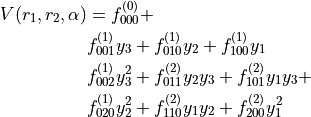
Note
The expansion terms are arranged by (1) the total order  and then by the increasing powers of
  for a given .
We now map parameter  to a 1D array
 ![f[n]](_images/math/bbf195d0428fe2ab369445f22119b40efc5b9f8b.png) with a single index
with a single index  with
the total number of polynomial coefficients of
with
the total number of polynomial coefficients of
(3)
where  is the number of the internal (expansion) degrees of freedom.
The mapping in our case is organised as follows:
|
|
|
|
1 |
0 |
0 |
0 |
2 |
0 |
0 |
1 |
3 |
0 |
1 |
0 |
4 |
1 |
0 |
0 |
5 |
0 |
0 |
2 |
6 |
0 |
1 |
1 |
7 |
1 |
0 |
1 |
8 |
0 |
2 |
0 |
9 |
1 |
1 |
0 |
10 |
2 |
0 |
0 |

Non-rigid reference configuration
For a non-rigid reference expansion case, a PEF expansion is given by

around each value of  and
and  are now expansion 1D functions.
Note
Remember that the non-rigid coordinate corresponds always to the last mode, in this case  .
.
The TROVE-form expansion to the second order is now given on a grid of ![\alpha_k = [\alpha_{\rm min} \ldots \alpha_{\rm max}]](_images/math/6ea37127fb949264d321d665363f96c8b71daca7.png) :
:
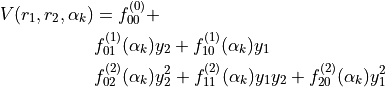
The mapping 3D-to-1D is now as follows
|
|
|
|
1 |
0 |
0 |
0 |
1 |
0 |
0 |
1 |
1 |
0 |
0 |
2 |
1 |
0 |
0 |
3 |
… |
… |
… |
… |
2 |
0 |
1 |
0 |
2 |
0 |
1 |
1 |
2 |
0 |
1 |
2 |
2 |
0 |
1 |
3 |
… |
… |
… |
… |
3 |
1 |
0 |
0 |
3 |
1 |
0 |
1 |
3 |
1 |
0 |
2 |
3 |
1 |
0 |
3 |
… |
… |
… |
… |
6 |
2 |
0 |
0 |
6 |
2 |
0 |
1 |
6 |
2 |
0 |
2 |
6 |
2 |
0 |
3 |
where  .
.
This structure of the mapping is used in TROVE for any arbitrary system of general dimension and also used in the fields’ checkpoints.
potential.chk
The checkpoint file potential.chk containing the expansion parameters  has three sections:
header with a defining the dimensionality.
main body with the expansion values and indexes
footer with a checkpoint “signature”
A potential.chk example for H2S can be downloaded from potential.chk.
Header
A typical potential.chk header has the following form:
0 2 10 <- Npoints,Norder,Ncoeff
with three integer parameters:
 defining the size of the grid of the non-rigid mode (0 for the rigid configuration).
 is the maximal expansion order.
 is the total number of the expansion coefficients (the non-rigid mode excluded) as in Eq. (3).
The field <- Npoints,Norder,Ncoeff is a comment, completely ignored by the TROVE read.
Main body
For the example of a 2nd order expansion, the body of potential.chk has the following structure:
 1        0  0.1204141314001783E-03
 2        0  0.2530099244534204E+01
 3        0  0.7599034116321027E+01
 4        0  0.7599034116321026E+01
 5        0  0.1909437919650396E+05
 6        0 -0.2632308040173431E+04
 7        0  0.3714665204913049E+05
 8        0 -0.2632308040173436E+04
 9        0 -0.3464213699036532E+03
10        0  0.3714665204913049E+05
Where
col 1: the 1D expansion index
 ;
;col 2: the non-rigid expansion index :max:`k = 0\ldots N_{\rm points}` (
 for the Rigid case);
col 3: the value of the expansion parameter
.
Note
The format is not sensitive to the exact position of the columns the exact format of the values in the last column with spaces as separators between then. The order of the column however is important, but the order of the rows is not!
Footer
The footer of potential.chk (and of other fields) is used to (i) indicate the end of the main body part and (ii) for a general control of the correctness of the file structure. It also reports the value of the coefficient threshold  used to prune the potential expansion from parameters wit very small values. It has the following generic format:
  987654321     0 0.00000000000E+00 <- End
 0.10000000E-23      <- sparse threshold used
End of potential
Here:
987654321is a signature card indicate the end of the main body section. The values in columns 2 and 3 are dummy and only used to maintain the structure when readingpotential.chkline-by-line.0.10000000E-23is the coefficient threshold valueEnd of potentialis an obligatory (case sensitive) signature at the end of the file. It is used to check the correctness of the input.
The input fields <- End and <- sparse threshold used are ignored by the TROVE read and only for clarity.
For a non-rigid XY2 case with  , the structure of
 potential.chk is as follows (for  ):
):
1       0      2.1950703863E+06
1       1      2.1950667601E+06
1       2      2.1950558811E+06
1       3      2.1950377475E+06
2       0      1.0824765910E+03
2       1      1.0822716655E+03
2       2      1.0816568852E+03
2       3      1.0806322393E+03
3       0      1.0824765910E+03
3       1      1.0822716655E+03
3       2      1.0816568852E+03
3       3      1.0806322393E+03
4       0     -3.9896888537E+06
4       1     -3.9896813769E+06
4       2     -3.9896589454E+06
4       3     -3.9896215557E+06
5       0      6.2738693377E+04
5       1      6.2739094227E+04
5       2      6.2740296812E+04
5       3      6.2742301244E+04
6       0     -3.9896888537E+06
6       1     -3.9896813769E+06
6       2     -3.9896589454E+06
6       3     -3.9896215557E+06
Kinetic Energy Operator checkpoint
The KEO has the following general form:
(4)![\begin{split}
\hat{T}
&= \frac{1}{2} \, \sum_{\alpha=x,y,z} \; \; \sum_{\alpha^\prime=x,y,z} \hat{J}_{\alpha}\, G_{\alpha,\alpha^\prime}^{\rm rot}(\xi)\, \hat{J}_{\alpha^\prime} \\
&+ \, \sum_{\alpha=x,y,z}\;\; \sum_{n=1}^{3N-6} \left[
\hat{J}_{\alpha}\, G_{\alpha,\lambda}^{\rm Cor}(\xi)\, \hat{p}_\lambda +
\hat{p}_\lambda \, G_{\alpha,\lambda}^{\rm Cor}(\xi)\, \hat{J}_{\alpha} \right] \\
&+ \, \sum_{\lambda=1}^{M}\; \sum_{\lambda^\prime=1}^{M}
\hat{p}_\lambda \, G_{\lambda,\lambda'}^{\rm vib}(\xi)\, \hat{p}_{\lambda'} + U(\xi),
\end{split}](_images/math/027c3b85e6172a77aa6627a667109ad7364d94d2.png)
It consists of four main components, rotational, Coriolis, vibrational and Pseudo-potential, represented by the corresponding KEO expansion terms  ,
,  ,
,  and
and  . Each of them is then represented by a Taylor-type expansion of Eq. (1), either around a rigid configuration (
 ) or a non-rigid one.
The multi-dimension expansions are mapped to a 1D array using the same structure as described for PEFs. The corresponding KEO parameters are saved in the checkpoint file kinetic.chk using the same format with additional specifiers for the KEO term indexes, e.g.  as in as well as to indicate which expansion component they belong to.
The kinetic.chk file is organised into four parts, vibrational, rotational, Coriolis and pseudo-potential (in this order). A kinetic.chk example for H2S can be downloaded from kinetic.chk.
As an example to illustrate its structure , let us use the example of XY2 again assuming the expansion order of  (rigid rotor KE). Each par ends with a one footer line:
987654321 0 0 0 0.00000000E+00 <- End
as described for potential.chk, and after the last section, the file ends with the footer:
 0.10000000E-23      <- sparse threshold used
End of kinetic
Note
Here End of kinetic is a case sensitive obligatory string on the very last line, treated as three words End, of and kinetic with spaces as decimeters.
The first part of kinetic.chk has the following format
    0        2       1           <- g_vib Npoints,Norder,Ncoeff
  ----- ------  ------- ------- -----------------------
  col 1  col 2   col 3   col 4          col 5
  ----- ------  ------- ------- -----------------------
     1     1       1       0        3.45080007E+01
     1     2       1       0       -4.16924395E-02
     1     3       1       0        7.88754390E-01
     2     1       1       0       -4.16924395E-02
     2     2       1       0        3.45080007E+01
     2     3       1       0        7.88754390E-01
     3     1       1       0        7.88754390E-01
     3     2       1       0        7.88754390E-01
     3     3       1       0        3.87191518E+01
     1     1       1       0        2.07473906E+01
     2     2       1       0        9.64742256E+00
     3     3       1       0        1.80323802E+01
     0     0       1       0       -6.05339917E+00
    ...............
987654321     0        0        0  0.00000000000E+00 <- End
col 1: the value of the index
 in
in col 2: the value of the index
 in
in col 3: expansion index
in Eq. (2).col 4: The non-rigid grid point
 (
( ), zero for the rigid and
col 5: Value of the expansion parameter
](_images/math/b899e1cba4f86f9f87ee00caff6da2246f17a0e5.png) .
.
The vibrational part is followed by the rotational part using the same structure:
    0        2        0          <- g_rot Npoints,Norder,Ncoeff
  ----- ------  ------- ------- -----------------------
  col 1  col 2   col 3   col 4          col 5
  ----- ------  ------- ------- -----------------------
     1     1       1       0        2.07473906E+01
     2     2       1       0        9.64742256E+00
     3     3       1       0        1.80323802E+01
    ...............
987654321     0        0        0  0.00000000000E+00 <- End
col 1: the value of the index
in 
col 2: the value of the index
 in
in col 3: expansion index
in Eq. (2).col 4: The non-rigid grid point
(), zero for the rigid and col 5: Value of the expansion parameter
](_images/math/fae287157ce6032e6df4a34d3595d458b91d7c5f.png) .
.
For the zero-order expansion, only the diagonal elements are present in the KEO of XY2.
The next part of kinetic.chk list the expansion parameters of . Sice this part is absent for the zero order expansion case, let us increase to 1 for the sake of an illustration:
    0        1       4           <- g_cor Npoints,Norder,Ncoeff
  ----- ------  ------- ------- -----------------------
  col 1  col 2   col 3   col 4          col 5
  ----- ------  ------- ------- -----------------------
     1    2        2       0       -6.44399927E+00
     1    2        3       0       -1.47113686E-01
     1    2        4       0        1.47113686E-01
     2    2        2       0        6.44399927E+00
     2    2        3       0       -1.47113686E-01
     2    2        4       0        1.47113686E-01
     3    2        3       0       -7.22166143E+00
     3    2        4       0        7.22166143E+00
    ...............
987654321     0        0        0  0.00000000000E+00 <- End
col 1: the value of the index
in col 2: the value of the index
in 
col 3: expansion index
in Eq. (2).col 4: The non-rigid grid point
(), zero for the rigid and col 5: Value of the expansion parameter
](_images/math/35cb6e5ea6beba4fa7222a69778f51a1b9c1751f.png) .
.
The last, pseudo-potential part, contains expansion coefficient of  . For the
  case it is given by:
     0        1       4          <- pseudo Npoints,Norder,Ncoeff
  0     0        1        0  -0.605339916936254152E+01
  0     0        2        0   0.494666955682775800E+00
  0     0        3        0   0.453132419899363814E+01
  0     0        4        0   0.453132419899363725E+01
987654321     0        0        0  0.00000000000E+00 <- End
cols 1-2: two dummy zero values just to keep the same structure as above
col 3: expansion index
in Eq. (2).col 4: The non-rigid grid point
(), zero for the rigid and col 5: Value of the expansion parameter
](_images/math/3771f14d3226963cddf13f93aaa33f4a54fa957c.png) .
.
The final part is the footer as examined above:
 0.10000000E-23      <- sparse threshold used
End of kinetic
Extended format of kinetic.chk
In the case of the Basic-Function feature used, the kinetic.chk format is required to contain the individual exponents for all modes of each term explicitly. For details, see Kinetic energy operators. The extended format has now the following form (example for the g_vib section):
 0   7   93    <--- Gvib Npoints,Norder,Ncoeff
 1     1     1   0   3.86412653967     0    0    0    0    0    0
 1     2     1   0   2.80960448197     0    0    0    1    0    0
 1     3     1   0   2.80960448197     0    0    0    0    1    0
 1     4     1   0  -2.80960448197     0    1    0    4    0    0
 1     5     1   0  -2.80960448197     0    0    1    0    4    0
 1     6     1   0               0     0    0    0    0    0    0
 2     1     1   0   2.80960448197     0    0    0    1    0    0
 2     2     1   0   36.2630831225     0    0    0    0    0    0
.....
where the first three integer numbers Npoints,Norder,Ncoeff are as before, , and , respectively with one important difference. is the number of non-zero coefficients. The columns of the main body are as follows:
----- ----- ---- --- ---------------- ---- ---- ---- ---- ----- ----
  1     2     3   4           5         6    7    8    9    10   11
----- ----- ---- --- ---------------- ---- ---- ---- ---- ----- ----
  1     1     1   0   3.86412653967     0    0    0    0    0    0
  1     2     1   0   2.80960448197     0    0    0    1    0    0
  1     3     1   0   2.80960448197     0    0    0    0    1    0
  .....
The first 5 columns are as before:
col 1: the value of the index
in col 2: the value of the index
in col 3: expansion index
in Eq. (2).col 4: The non-rigid grid point
(), zero for the rigid and col 5: Value of the expansion parameter
.
The rest 6 columns contain the corresponding exponents of each mode in Eq. (2).
col 6:

col 7:

col 8:

col 9:

col 10:

col 11:
 (i.e.
(i.e.  ).
).
External field checkpoint
This is a genial purpose field, used for example to store the dipole moment, correction to the PEF in the refinement etc. It is assumed to be a 1D array of the dimensionality  (
( for the dipole).
It follows the same structure as above, just with one index representing the field component. For example:
3000        6       28        3          <- Npoints,Norder,Ncoeff,Rank
  1        1        0 -0.7458479825692242E+00
  1        1        1 -0.7491358566222752E+00
  1        1        2 -0.7524174492956430E+00
  1        1        3 -0.7556927371155667E+00
  1        1        4 -0.7589616967156357E+00
  1        1        5 -0.7622243048371204E+00
  1        1        6 -0.7654805383293001E+00
............
In the first line here, the last number specifies the dimensionality of the field (here 3).
As before, the checkpoint file ends with the footer
  987654321     0        0  0.00000000000E+00 <- End
 0.00000000E+00      <- no sparse was threshold used
End of external
An external.chk example for H2S can be downloaded from external.chk.