Z-matrix
TROVE uses the standard Z-matrix scheme to define the molecular structure and introduce the basic internal coordinates, which are Z-matrix coordinates in TROVE. For, example, the hydrogen peroxide HOOH coordinate system is defined using the following Z-matrix defined with the ZMAT card:
ZMAT
    O1  0  0  0  0  15.99491463
    O2  1  0  0  0  15.99491463
    H1  1  2  0  0   1.00782505
    H2  2  1  3  2   1.00782505
end
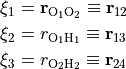
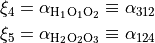
Here, the Zmatrix coordinates are as follows.
Three valence bond length (stretching) coordinates 1,2,3:
Two valence bond-angle (bending) coordinates 4,5:
One dihedral coordinate defined as a book angle
 between planes
  and {rm H}_2{rm O}_2 {rm O}_3:

which is defined as follows
![\delta_{ijkl} = \arccos\left(\frac{[\vec{r}_{ij} \times \vec{r}_{jk}]\cdot[\vec{r}_{jk} \times \vec{r}_{kl}] }{|[\vec{r}_{ij} \times \vec{r}_{jk}]| | [\vec{r}_{jk} \times \vec{r}_{kl}]|}\right).](_images/math/4c0de2b2893ed97dd700aa028262309146a7151a.png)
Structure of the Zmatrix block
Let us consider the HOOH example above to describe the columns in the ZMAT block:
col |
1 |
2 |
3 |
4 |
5 |
6 |
row |
atom |
connector 1 |
connector 2 |
connector 3 |
Type |
Mass |
1 |
O1 |
0 |
0 |
0 |
0 |
15.99491463 |
2 |
O2 |
1 |
0 |
0 |
0 |
15.99491463 |
3 |
H1 |
1 |
2 |
0 |
0 |
1.00782505 |
4 |
H2 |
2 |
1 |
3 |
2 |
1.00782505 |
Here:
Col 1 (atom): A label for the name of the atom; it is not interpreted by the program and is currently only for clarity.
Col 2 (connector 1): The 1st connecting atom to form a molecular bond.
Col 3 (connector 2): The 2nd connecting atom to form a bond angle.
Col 4 (connector 1): The 3rd connecting atom to form a dihedral angle or other type angle, depending on the value in column Type.
Col 5 (Type): A “Dihedral” angle type (see below).
Col 6 (Mass): The mass of the particle; usually an atomic but sometimes a nuclear mass.
“Dihedral” types
The following “Dihedral” types are available:
Type 0: the “Dihedral” angle is defined as a valence angle between bonds
 and
and  as shown in the figure.

Z-matrix coordinates with a dihedral angle of type 0 used for rigid molecules like PH3.
Type 1: it is defined as a usual dihedral angle between two planes (4-1-2 and 3-1-2), with important addition. One more bond angle
 is introduced (see the figure and also Ammonia example in Molecules).

Z-matrix coordinates with a “dihedral” angle of type 1 used for NH3.
Type 2: it is the standard dihedral angle as in the HOOH example above.

Z-matrix coordinates with a dihedral angle of type 2 used for HOOH as in the example above.
Type 202: it is the same dihedral angle
 as type 2, with the difference that the 1st derivative of wrt the Cartesian coordinates (required for the KEO construction) are evaluated using the finite differences, while for types 0, 1, 2, -2, 3-100 the 1st derivatives are evaluates using an analytic expression. Finite difference offer more stable evaluation at positions where the phases of the angles change (0,
  ,
,  ) which makes their definition ambiguous.
Type -2: it is the standard dihedral angle, but with the “backbone” vector inverted, see figure.

Z-matrix coordinates with a “dihedral” angle of type -2 used for HOOH with the “backbone” vector inverted.
A differen example of type 2 of dihedrals is for H2CO with the Z-matrix given by
ZMAT
    C   0  0  0  0  12.00000000
    O   1  0  0  0  15.99491463
    H   1  2  0  0   1.00782505
    H   1  2  3 -2   1.00782505
end

Z-matrix coordinates with a “dihedral” angle of type -2 used for H2CO with the “backbone” vector inverted.
Here is a Z-matrix used for C2H4 with a mixture of types 2 and -2:
ZMAT
  C   0  0  0  0  12.00000000
  C   1  0  0  0  12.00000000
  H   1  2  0  0   1.00782505
  H   1  2  3 -2   1.00782505
  H   2  1  3  2   1.00782505
  H   2  1  5 -2   1.00782505
end
The system was studied in [18MaYaTe].
Type -202: same as type, but the 1st derivative of
wrt the Cartesian coordinates evaluated using the finite differences.Type 402: it is the same as type 202, but with
defined in the extended range from 0 to 720. This type is useful for the systems with the extended molecular symmetries, such as non-rigid HOOH [15AlOvYu] or C2H6 [19MeYuMa].Type -402: it is the same as type -202, but with
defined in the extended range from 0 to 720.
Type 3-100: any number
 between 3 and 100 means that instead of a dihedral angle, another bond angle is introduced; the “type” card is treated as an additional connector in order to define the bond angle. As example, the following Z-matrix (see the figure) uses a dihedral angle free definition of the vibrational coordinates of CH4:
ZMAT
    C   0  0  0  0  12.000000000
    H   1  0  0  0   1.007825035
    H   1  2  0  0   1.007825035
    H   1  2  3  0   1.007825035
    H   1  2  3  4   1.007825035
end