RichMol: Interfacing with other molecular codes
Richmol is a package aimed at providing simple and efficient platform for simulations of ro-vibrational energies, spectra, and dynamics in the presence of external (laser) and induced internal (hyperfine) electromagnetic fields for general molecule [18OwYa], [21SaYaZa]. Richmol can be interfaced with other variational codes, like TROVE and Duo.
The role of TROVE is to provide the interacting molecular properties (dipole moments, polarizabilities etc) in the so-called spectral representations, i.e.inthe representation of field-free ro-vibrational eigenfunctions. Consider, e.g., a Hamiltonian operator describing the molecule interacting with a general time-dependent electro-magnetic field  :
:

where  is a dipole moment vector and
  is a polarizability rank 2 tensor. In the spectral representation,
  is given by the matrix elements
(1)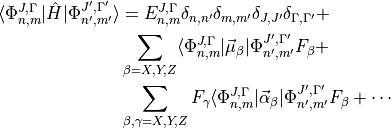
where  is an eigenfunction and
  is an eigenvalue of the field free Hamiltonian:
(2)
 is the rotational angular momentum,
  is its projection on the space-fixed axis
  ,
,  is an irrep of the (field-free) molecule and
  is a general eigen-state counting number. Thus, this is TROVE’s role to solve Eq. (2) and to compute the corresponding matrix elements of the properties in Eq. (1). It is then the role of RichMol to find the time dependent solution for the molecule interacting with and thus to solve for the molecular dynamics:
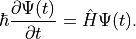
Similarity, RichMol can be also used to solve a general eigen-problem

in a spectral representation of an unperturbed Hamiltonian (Eq. (2)):

How to interface TROVE with RichMol
First of all, the user must provide a Fortan subroutine for the property in question for calculating their values at any arbitrary molecular geometry :math`vec{r}`. Consider e.g. a polarizability tensor as a set of surface components  , where
  are projections on the molecular fixed axes. In TROVE, the property is processed through the block
 External in the same way as for the dipoles or for the correction of PEF used in refinements.
Step 1
Control
 Step 1
 external
end
Follow the same general procedure described in TROVE Quick start and use the external block to define the polarizability components, e.g.
external
  dimension 6
  NPARAM  5 2 2 2 2 2
  DMS_TYPE ALPHA_C2H6_ZERO
  COEFF   list
  COORDS  linear
  Order   0
  compact
  parameters
  re1     1.52563613
  re2      1.09068849
  beta   111.19731929
  alphaxx0      -26.595
  alphaxx3      0.1004
  alphaxy0      0.0
  alphaxy3      0.0
  alphaxz0      0.0
  alphaxz3      0.0
  alphayy0     -26.595
  alphayy3      0.1004
  alphayz0      0.0
  alphayz3      0.0
  alphazz0      -30.336
  alphazz3      0.0824
end
which represents a simplistic form of the polarizability tensor of C2H:sub:6 using the TROVE function ALPHA_C2H6_ZERO.Here, there are six independent components each of which is represented by a single value (cards alpha***) at the molecular equilibrium (cards re1, re2 and beta).
Step 2
Business as usual:
Control
 Step 2
 external
end
Step 3
Business as usual, e.g.:
Control
 Step 3
 J 0
end
Step 4
This is the main step of computing the matrix elements of , for which the Intensity card is used. We first define the calculation step 4 in the control block (anywhere in the input file):
Control
 Step 4
 J 0,1
end
and then define the intensity block using the RichMol-related cards field_me in conjunction with oper_alpha, e.g.
INTENSITY
  field_me
  oper alpha
  THRESH_INTES  1e-10
  THRESH_LINE   1e-10
  THRESH_COEFF  1e-20
  GNS          6.0 10.0 6.0 10.0 4.0 4.0 2.0 6.0 12.0 0 0 0 0 0 0 0 0 0
  selection (rules) 1 2 3 4 5 6 7 8 9 10 11 12 13 14 15 16 17 18
  J, 6,8
  freq-window  0, 10000
  energy low   -0.001, 10000.00, upper   -0.001, 10000.0
END
The keyword field_me is to switch on the “Field’s Matrix Elements”. The keyword oper is to specify which type of the property to process; in this case it is the polarizability (alpha).
Currently, the following properties are available in TROVE (see module extfield.f90):
ALPHA: polaizability tensor;MU: dipole moment vector;QUAD: quadrupole moment tensor;SPINROT: spin-rotation tensor;SPINSPIN: spin-spin tensor;GTENS: g-tensor;WIGNER: Wigner matrixCOSTHETA: ;
;J: J-tensor;COS2THETA: ;
;RICHMOL_LEVELS_FILE: TBP;MF_TENSOR: TBP.