Quantum numbers
Largest basis set contribution approach
The main concept behind assigning vibrational quantum numbers is to compare vibrational eigenfunctions  (or corresponding densities
  ) to and associate with some reference wavefunctions with well defined quantum numbers, e.g. basis functions.
TROVE uses the largest coefficient approach from the expansion of eigenvectors in terms of the basis functions.
Consider, for example, variationally computed wavefunctions of the form
) to and associate with some reference wavefunctions with well defined quantum numbers, e.g. basis functions.
TROVE uses the largest coefficient approach from the expansion of eigenvectors in terms of the basis functions.
Consider, for example, variationally computed wavefunctions of the form
(1)
An eigen-state is said to inherit quantum numbers  of the most ‘similar’ basis function
  . According to the largest contribution concept used in TROVE, the eigen-state
  is assigned the excitation numbers
  that correspond to the largest basis set contribution measured by the corresponding expansion (eigen-)coefficient
  . The accuracy of this approach depends on the quality of the basis set and can only provide meaningful information when the coupling between different basis set components is relatively small, i.e. when the magnitude of the largest coefficients is well separated from other contributions. The magnitude of the largest coefficient plays a role of a similarity index between the TROVE eigenfunction and the corresponding reference (basis) function.
1D Primitive basis set
The primitive basis functions can be either numerically generated by solving the corresponding Schrödinger equation (e.g. variationally or using the Numerov method) or one of the established orthogonal basis sets, such as Harmonic oscillators. In the latter case, the basis functions as given the corresponding excitation index:

where  is a Hermite polynomial. For the numerically generated basis functions obtained variationally, TROVE uses the largest contribution approach described above to assign quantum numbers to the basis functions. For the basis functions obtained using the Numerov-Cooley approach, the excitation indexes of the corresponding 1D wavefunctions are estimated by counting the nodes.
Assignment of the ‘contracted’ symmetry adapted basis functions
Following the TROVE pipeline of step 1, after the 1D primitive basis functions are contracted, TROVE solves reduced Hamiltonians for a set of sub-classes with the goal of building a symmetry adapted contracted basis set. These reduced problems are solved variationally and therefore the corresponding eigen-functions can be assigned the quantum numbers using the largest contribution approach. Here TROVE uses its native quantum numbers that directly correspond to the basis set as defined in the section BASIS. For example, or a symmetric triatomic molecule of the type XY2, a typical Basis set is defined as follows
BASIS
 0,'JKtau', Jrot 0
 1,'numerov','linear', 'morse', range 0,  4,  resc 1.0, points 600,borders -0.5,1.40
 1,'numerov','linear', 'morse', range 0,  4,  resc 1.0, points 600,borders -0.5,1.40
 2,'numerov','linear', 'linear', range 0, 4,  resc 1.0, points 4000,borders   4.0,150.0 deg
END
where the first line corresponds to the rotational basis set (sub-class 0), lines 2 and 3 belong to sub-class 1 containing two stretching modes XY1 and XY2. The last line describes the bending mode from sub-class 2. After solving the reduced vibrational problem for class 1, the energies in the TROVE standard output are printed out as given by
Symmetry of the contracted solution, class:   1
     i       ener         deg  symmetry  quanta:
     1        0.00000000   1   1  A1     0   0   0    0
     2     2606.33588428   1   1  A1     1   0   0    0
     3     3289.35032517   1   4  B2     0   1   0    0
     4     5167.94761210   1   1  A1     1   1   0    0
     5     5792.74038338   1   4  B2     0   2   0    0
     6     6500.04075468   1   1  A1     1   1   0    0
     7     7704.33822743   1   1  A1     2   1   0    0
     8     8334.12791848   1   4  B2     0   3   0    0
     9     9079.13120953   1   1  A1     0   3   0    0
    10     9911.69433846   1   4  B2     1   2   0    0
    11    10163.09614410   1   1  A1     2   2   0    0
    12    10789.04196300   1   4  B2     4   0   0    0
    13    11578.19544716   1   1  A1     4   0   0    0
    14    12431.56258951   1   4  B2     3   1   0    0
    15    13239.83629333   1   1  A1     2   2   0    0
where the 1st column (i) is a counting index of the contracted solution for sub-class 1; the 2nd column (ener) contains the energies (in wavenumbers); col 3 (deg) shows the degeneracy of the state (here it is 1 for the C2v(M) symmetry group), columns 4 and 5 contain the symmetry (irrep), the symmetry index (1,2,3,4) and the symmetry label (A1, A2, B1, B2); cols 6 and 7 are the stretching quantum  ; col 8 gives bending quantum number (here it is zero for the stretching sub-class) and the last column is reserved for the rotational quantum number of sub-class 0 (not used in practice for the vibrational basis sets).
The exact distribution of the tow quanta between the two equivalent stretching modes is random, only the total quanta  has a physical meaning plus the total symmetry. Using these two criteria it is usually possible to match the TROVE (local mode) quantum numbers to the spectroscopic (normal mode) quantum numbers. Form example, the energy state 2 (
 cm-1) is assigned (1,0)
 A1, which is the (1,0,0) state in the normal mode notation. The next energy state 3 ( cm-1) is (0,1)
 B2 has the same total number of quanta (1), but has the symmetry  , which corresponds to the (0,0,1) state in the normal mode notation.
The second sub-class in the case of the XY2 molecules is classified as follows:
Symmetry of the contracted solution, class:   2
     i       ener         deg  symmetry  quanta:
     1        0.00000000   1   1  A1     0   0   0    0
     2     1186.71845689   1   1  A1     0   0   1    0
     3     2368.45025285   1   1  A1     0   0   2    0
     4     3547.01501601   1   1  A1     0   0   3    0
     5     4728.42983827   1   1  A1     0   0   4    0
with only one active TROVE mode 3  , which is directly mapped to the normal mode states
  .
.
Rotational basis set and quantum numbers
TROVE uses the rigid rotor wavefunctions  , where
  is the total angular momentum in units of
  , while
  and
and  are the rotational quantum numbers, describing its projection onto laboratory
  and molecular
  -axes, respectively, which satisfy

In calculations of ro-vibrational energy, plays no direct role and can be ignored. The quantum number is however a critical quantity, defined by the choice of the -axes. For asymmetric tops, it is common in spectroscopic applications to choose along the axis with the smallest moment of inertia, such as frames R-RHO-Z or R-ALPHA-Z used for quasi-linear XY:sun:`2` molecules. For symmetric tops, the axis is taken as the symmetry axis, such as the R-ALPHA and R-S-DELTA frames used for the XY3 type. The spherical top XY4 will be discussed separately.
TROVE uses symmetry adapted rotational basis functions. For asymmetric and symmetric tops, these are the so-called Wang functions  ), which are given by
(2)![\begin{split}
&|J,0,\tau\rangle = |J,0\rangle, \quad \tau = J\; \hbox{mod}\; 2 , \\
&|J,K,\tau=0\rangle = \frac{1}{\sqrt{2}} \left[ |J,K,m\rangle + (-1)^{J+K} |J,-K,m\rangle \right],\\
&|J,K,\tau=1\rangle = \frac{i (-1)^{\sigma} }{\sqrt{2}} \left[ |J,K,m\rangle - (-1)^{J+K} |J,-K,m\rangle \right].
\end{split}](_images/math/d4054816d81f7d660f90686bd63a4a7e64789b0b.png)
Here  ,
,  is the value associated with the parity of
  and is omitted on the left-hand side for simplicity’s sake. The meaning of
  is explained below.
  is commonly used as the rotational quantum number,
  or
or  , depending on the orientation of the axis. The sign of is, however, not a physically meaningful quantity of a rotational eigen-state, but the parity is.
The functions allow one to classify them according with the corresponding molecular symmetry group they belong to. This is done by following the symmetry properties of the rigid rotor wavefunctions upon the group transformations. For example, the XY2 Wang functions transform as irreps  of the C2v`(M) group (:math`Kne 0), which are defined by the quantum numbers
  as follows
|
|
|
|
|
|
|
|---|---|---|---|---|---|---|
even |
0 |
|
odd |
0 |
|
|
even |
1 |
|
odd |
1 |
|


As in the case of the vibrational quantum numbers, the rotational components of the ro-vibrational eigenstates are also assigned using the largest contribution approach. Hence, the rotational quantum numbers are
: a rotational index defining the state parity;
: the rotational symmetry.
Due to symmetry  , the parity is in fact redundant.
The mappings between the and appear in modules mol_*.f90. For example, for this C2v`(M) example of a XY:sub:`2 type molecule the mapping is given by (see mol_xy2.f90):
   !
case('C2V','C2V(M)')
   !
   gamma = 0
   ideg = 1
   if (mod(K+2,2)==0.and.tau==0) gamma = 1
   if (mod(K+2,2)==0.and.tau==1) gamma = 2
   if (mod(K+2,2)/=0.and.tau==0) gamma = 4
   if (mod(K+2,2)/=0.and.tau==1) gamma = 3
   !
The symmetry classification of the rotational basis functions can be also found in the standard TROVE output:
Symmetry of the contracted solution, class:   0
     i       ener         deg  symmetry  j   k  tau  quanta:
     1      151.97406555   1   1  A1     4   0   0   0   0   0
     2      153.39155239   1   4  B2     4   1   0   0   0   0
     3      153.39155239   1   3  B1     4   1   1   0   0   0
     4      157.64401293   1   1  A1     4   2   0   0   0   0
     5      157.64401293   1   2  A2     4   2   1   0   0   0
     6      164.73144716   1   4  B2     4   3   0   0   0   0
     7      164.73144716   1   3  B1     4   3   1   0   0   0
     8      174.65385507   1   1  A1     4   4   0   0   0   0
     9      174.65385507   1   2  A2     4   4   1   0   0   0
where class: 0 corresponds to the rotational sub-set = 0.
Td symmetry
The Wang-functions cannot be used for symmetry adaptation of the Td rotational basis. This is because the group symmetry transformations cannot be associated with equivalent rotations about the  ,
,  or axes only. As a result, symmetry-adapted rotational functions are obtained as a general linear combinations of with spanning all
  . Because of that, the rotational quantum number can no longer be used for classification of the symmetrised rigid-rotor combinations. Instead they are labelled as
  , where is the symmetry and
  is a counting index:
(3)
Assignment of the ro-vibrational eigen-functions
Once the individual vibrational basis set components are defined together with their quantum number classifications, the (ro-)vibrational basis set is constructed as a direct product of its components. The latter inherits the quantum numbers of the individual components to form the assignment of the (ro-)vibrational basis functions. For example, by combining
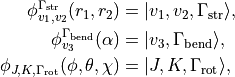
a ro-vibrational basis function :math`phi_{J,K,v_1,v_2,v_3,Gamma_{rm tot}}` is formed as a symmetrised combination:

The ro-vibrational eigenfunctions are computed variationally on the basis the symmetry adapted basis of  . The TROVE quantum numbers obtained using the largest contribution approach eigenfunction thus include:
is the total symmetry (irrep) of the corresponding molecular symmetry group.
are the TROVE (local mode) quantum numbers.
is the vibrational symmetry of the corresponding molecular symmetry group.
TROVE energy output
Consider an example of H2S calculations. The the J=0 energy output for the total symmetry  is given by
------ ------ ------------- ------- --- -- --- ---- ----- ---- --- ------ -------- ------ --- --- --- -------- -----
  1        2        3           4    5  6  7    8    9     10   11  12       13      14  15  16  17       18    19
------ ------ ------------- ------- --- -- --- ---- ----- ---- --- ------ -------- ------ --- --- --- -------- -----
G_tot      n     Energy        G_r   J  K  t    Gv1 Gv2     v1  v2  v3       C_i      n1  n2  n3  l    ivib1   ivib2
------ ------ ------------- ------- --- -- --- ---- ----- ---- --- ------ -------- ------ --- --- --- -------- -----
 A1        1      0.000000   ( A1 ;  0  0  0 ) ( A1  A1 ;   0   0   0 )      1.00 (   0   0   0   0 ) (    1    1 )
 A1        2   1172.667646   ( A1 ;  0  0  0 ) ( A1  A1 ;   0   0   1 )      1.00 (   0   0   1   0 ) (    1    2 )
 A1        3   2335.297519   ( A1 ;  0  0  0 ) ( A1  A1 ;   0   0   2 )      0.98 (   0   0   2   0 ) (    1    3 )
 A1        4   2608.713940   ( A1 ;  0  0  0 ) ( A1  A1 ;   1   0   0 )      0.99 (   1   0   0   0 ) (    2    1 )
 A1        5   3503.042415   ( A1 ;  0  0  0 ) ( A1  A1 ;   0   0   3 )      0.95 (   0   0   3   0 ) (    1    4 )
 A1        6   3765.459944   ( A1 ;  0  0  0 ) ( A1  A1 ;   1   0   1 )      0.95 (   1   0   1   0 ) (    2    2 )
 A1        7   4675.006191   ( A1 ;  0  0  0 ) ( A1  A1 ;   0   0   4 )      0.92 (   0   0   4   0 ) (    1    5 )
 ...........
 ...........
where the designation of the columns is as follows
Col 1:
G_totis the total symmetry of a ro-vibrational state;Col 2:
nis the counting number of the energy;Col 3:
Energyterm value of the state;Col 4:
G_ris the rotational symmetry;Col 5:
Jis the total angular momentum rotational quantum number;Col 6:
kis a rotational quantum number (projection ofCol 7:
tis a rotational index defining the state parityCol 8-9:
Gv1areGv2are the vibrational symmetries of the corresponding vibrational sub-classes;Cols 10-12:
v1,v2,v3are the TROVE (local mode) vibrational quantum numbers;Col 13:
C_iis the largest eigen-coefficient used in the assignment.Cols 14-17:
K, n1, n2, n3are placeholder for the user-defined quantum numbers to be propagated to the final ro-vibrational eigenstates.Cols 18-19:
ivib1,ivib2are the counting indices of sub-classes in the representation of direct products of the symmetry adapted ‘contracted’ basis set.
It should be noted that for equivalent modes, such as the two stretches in the case of H2S, only their total quanta is meaningful, not the individual values. For example, the following TROVE stretching states  , and
, and  (
( ) are equivalent and cannot be distinguished without some extra information (e.g. their symmetry).
Similarity, the symmetry TROVE output is given by
Variational solution - irreducible representation
  Gamma     i       value             j  k  t   quanta
  B2        1   3280.145078   ( A1 ;  0  0  0 ) ( B2  A1 ;   0   1   0 )      1.00 (   1   0   0   0 ) (    3    1 )
  B2        2   4415.876421   ( A1 ;  0  0  0 ) ( B2  A1 ;   0   1   1 )      0.99 (   1   0   1   0 ) (    3    2 )
  B2        3   5556.806722   ( A1 ;  0  0  0 ) ( B2  A1 ;   0   1   2 )      0.97 (   1   0   2   0 ) (    3    3 )
  B2        4   5785.428853   ( A1 ;  0  0  0 ) ( B2  A1 ;   0   2   0 )      0.99 (   2   0   0   0 ) (    5    1 )
  B2        5   6717.570020   ( A1 ;  0  0  0 ) ( B2  A1 ;   0   1   3 )      0.96 (   1   0   3   0 ) (    3    4 )
  B2        6   6914.548146   ( A1 ;  0  0  0 ) ( B2  A1 ;   0   2   1 )      0.96 (   2   0   1   0 ) (    5    2 )
  B2        7   8041.707663   ( A1 ;  0  0  0 ) ( B2  A1 ;   0   2   2 )      0.98 (   2   0   2   0 ) (    5    3 )
  ....
The non-rigourous quantum numbers and  are defined using the largest eigen-coefficient approach and are approximate. They represent the measure of how the given wavefunction is similar to a single selected basis set function selected as the largest contribution the corresponding expansion. The quality of the assignment can be judged based on the expansion eigen-coefficients
(column with numbers
are defined using the largest eigen-coefficient approach and are approximate. They represent the measure of how the given wavefunction is similar to a single selected basis set function selected as the largest contribution the corresponding expansion. The quality of the assignment can be judged based on the expansion eigen-coefficients
(column with numbers  and two decimal points): coefficients smaller than 0.7 indicate that the corresponding quantum number are less reliable. Due to this approximate nature of the TROVE quantum numbers, the TROVE assignment is usually not complete and unambiguous. It is common to find states with duplicate assignments as well as some missing combinations (see Quantum Numbers).
Assignment using second and higher order largest coefficients
The largest coefficient approach start failing with increasing excitations leading to not-reliable and even wrong assignments. It is not uncommon to see different states with idealistical quantum numbers and therefore other legitimate assignments missing. In order to help resolve ensuing ambiguity and degeneracies, the quantum numbers from the second, third etc largest contribution can be printed. This feature can be activated using the NASSIGNMENTS keyword as part of the PRINT section. The section can appear anywhere in main body of the input file, for example:
DIAGONALIZER
 SYEV
 enermax 20000
end

print
 Nassignments  2
end
where the card NASSIGNMENTS (alias N_EIGEN-CONTRIBUTIONS) defines the number of the largest coefficients assignments to generate.
Quantum numbers in the  representation
The ro-vibrational calculations in the representation (step 3) are characterised by a single contracted sub-class with the basis set given by

Phi_{lambda}^{(J=0)} |J,K,taurangle,
where  is a rigid rotor basis function. Therefore, in this case the energy output has a slightly different form:
------ ------ ------------- ------- --- -- --- ----- ----- --- ----   -------- ------ --- --- --- --------
  1        2        3           4    5  6  7     8      9  10   11       12       13   14 15  16       17
------ ------ ------------- ------- --- -- --- ----- ----- --- ----   -------- ----- --- --- ---- --------
G_tot      n     Energy        G_r   J  K  t     Gv    v1  v2  v3        C_i     n1   n2  n3  l      ivib
------ ------ ------------- ------- --- -- --- ----- ----- --- ----   -------- ----- --- --- ---- --------
 A1        1   3329.579210   ( B2 ;  1  1  0 ) ( B2 ;   0   1   0 )      1.00 (   1   0   0   0 ) (    5 )
 A1        2   4465.843673   ( B2 ;  1  1  0 ) ( B2 ;   0   1   1 )      1.00 (   1   0   1   0 ) (    8 )
 A1        3   5607.333481   ( B2 ;  1  1  0 ) ( B2 ;   0   1   2 )      1.00 (   1   0   2   0 ) (   12 )
 A1        4   5834.782843   ( B2 ;  1  1  0 ) ( B2 ;   0   2   0 )      1.00 (   2   0   0   0 ) (   13 )
 A1        5   6770.421491   ( B2 ;  1  1  0 ) ( B2 ;   0   1   3 )      1.00 (   1   0   3   0 ) (   17 )
 A1        6   6964.556323   ( B2 ;  1  1  0 ) ( B2 ;   0   2   1 )      1.00 (   2   0   1   0 ) (   18 )
where
Col 8:
Gvis now a single vibrational symmetryCol 17:
ivibis a single counting index of the vibrational symmetry adapted ‘contracted’ basis set.
In fact, ivib is an unique vibrational ID and can be used to track the vibrational quantum numbers through the ro-vibrational calculations.
‘Normal mode’ quantum numbers
It is common for spectroscopic applications to relate the vibrational assignment to normal mode quantum numbers with the associated harmonic normal mode wavefunctions. Correlating TROVE local mode quantum numbers to the normal mode ones is not always trivial. Consider the above H2S example. The normal mode quantum numbers for this C2v(M) molecule are  , where
  represents a symmetric stretch (),
 is a symmetric bend () and
  an asymmetric stretch (). In the corresponding TROVE quantum numbers scheme
  , are two equivalent local mode stretches (un-symmetrised) and is a bending quantum number.
It is trivial to assign normal mode quantum numbers to the following lowest 5 vibrational states based on their quanta and symmetries:
G_tot |
n |
Energy |
v1 |
v2 |
v3 |
n1 |
n2 |
n3 |
|---|---|---|---|---|---|---|---|---|
A1 |
1 |
0.000000 |
0 |
0 |
0 |
0 |
0 |
0 |
A1 |
2 |
1172.667646 |
0 |
0 |
1 |
0 |
1 |
0 |
A1 |
3 |
2335.297519 |
0 |
0 |
2 |
0 |
2 |
0 |
A1 |
4 |
2608.713940 |
1 |
0 |
0 |
1 |
0 |
0 |
B2 |
5 |
3280.145078 |
0 |
1 |
0 |
0 |
0 |
1 |
Indeed, all the pure bending TROVE quantum numbers  can be directly mapped to the normal mode quantum numbers
  .
For the stretching modes, although only the sum of the TROVE quantum numbers is unambiguous, the correlation to the normal modes can be established with the help of the symmetry:
.
For the stretching modes, although only the sum of the TROVE quantum numbers is unambiguous, the correlation to the normal modes can be established with the help of the symmetry:  is
is  and
and  is
is  .
.
It is less trivial for higher excitations, where knowing the symmetry  of different stretching combinations corresponding to the same value of is not enough to resolve the ambiguity. What helps in this case is to notice that the energy quanta of the stretching component is lower than that of . Combining this assumption with the state symmetry allows one to correlate the TROVE and normal model quantum numbers to the other vibrational states as given by
G_tot
n
Energy
v1
v2
v3
n1
n2
n3
A1
6
3503.042415
0
0
3
0
3
0
A1
7
3765.459944
1
0
1
1
1
0
B2
8
4415.876421
0
1
1
0
1
1
A1
9
4675.006191
0
0
4
0
4
0
A1
10
4927.853585
1
0
1
1
2
0
A1
11
5171.458835
1
1
0
2
0
0
B2
12
5556.806722
0
1
2
0
2
1
B2
13
5785.428853
0
2
0
1
0
1
A1
14
6063.870902
1
0
3
1
3
0
A1
15
6318.807464
1
1
1
2
1
0
B2
16
6717.570020
0
1
3
0
3
1
B2
17
6914.548146
0
2
1
1
1
1
It is however less trivial to use this approach for rotationally excited states  , for larger number of sub-states and for degenerate symmetries. In the following chapter, we show, how the checkpoint file contr_descr.chk can be used to map the TROVE quantum numbers to the normal mode ones at the sub-class level and then propagate them to any the ro-vibrational state.
Assigning ‘normal mode’ quantum numbers
Considering that different vibrational and rotational contributions can be heavily mixed in the final ro-vibrational eigen-vectors, correlating the TROVE and spectroscopic (‘normal mode’) quantum numbers (QN) can be challenging. It is therefore instructive to start correlating them as earlier in calculation pipeline as possible. The earliest stage when this can be sensibly done is for the symmetry adapted reduced contractions. The correlation is not a straightforward procedure, currently requiring a human to build a mapping between the TROVE local mode and normal mode representation. The propagation of this mapping is done via a QN placeholder in the descr checkpoint files.
Consider for example the local to normal mode mapping presented above for the H2S example. Using this correlation, we can modify the QN placeholder section in the contr_descr.chk file as follows:
Class #       1
            15            15  <-  number of roots and dimension of basis

                                                 ---- --- ---      --- ---- ---
                                                  v1  v2  v3        n1  n2  n3
                                                 ---- --- ---      --- ---- ---
      1   1       1   1   3631.457962557469   0   0   0   0     0   0   0   0         0.99650855
      2   1       2   1   6237.793846833702   0   0   1   0     0   1   0   0        -0.70449312
      3   4       3   1   6920.808287732268   0   1   0   0     0   0   0   1         0.69933488
      4   1       4   1   8799.405574657821   0   1   1   0     0   2   0   0        -0.66971512
      5   4       5   1   9424.198345933786   0   0   2   0     0   1   0   1         0.69495690
      6   1       6   1  10131.498717237881   0   1   1   0     0   0   0   2         0.72224834
      7   1       7   1  11335.796189988205   0   2   1   0     0   3   0   0        -0.57998640
      8   4       8   1  11965.585881042271   0   0   3   0     0   2   0   1         0.62572431
      9   1       9   1  12710.589172085258   0   3   0   0     0   1   0   2        -0.55924495
     10   4      10   1  13543.152301015232   0   1   2   0     0   0   0   3         0.61849364
     11   1      11   1  13794.554106652784   0   2   2   0     0   4   0   0         0.55571833
     12   4      12   1  14420.499925557249   0   4   0   0     0   3   0   1         0.55493771
     13   1      13   1  15209.653409713983   0   4   0   0     0   2   0   2         0.58837860
     14   4      14   1  16063.020552071870   0   1   3   0     0   1   0   3         0.54684816
     15   1      15   1  16871.294255882527   0   2   2   0     0   0   0   4         0.65892621
Class #       2
             5             5  <-  number of roots and dimension of basis
                                                 ---- --- ---      --- ---- ---
                                                  v1  v2  v3        n1  n2  n3
                                                 ---- --- ---      --- ---- ---
     16   1       1   1   3676.343781669159   0   0   0   0     0   0   0   0         0.99914576
     17   1       2   1   4863.062238559608   0   0   0   1     0   0   1   0        -0.99741510
     18   1       3   1   6044.794034517188   0   0   0   2     0   0   2   0        -0.99558857
     19   1       4   1   7223.358797674689   0   0   0   3     0   0   3   0        -0.99426327
     20   1       5   1   8404.773619941838   0   0   0   4     0   0   4   0         0.99669840
End Quantum numbers and energies
The format of this checkpoint file contr_descr.chk is not sensitive to the number of spaces between the columns, but is sensitive to their order as well as to the order of the lines.
This file can be then read into the TROVE pipeline using the TROVE restart procedure at step 1 by modifying the CHECK_POINT section as follows
CHECK_POINT
 ascii
 kinetic     read
 potential   read
 basis_set   read
 contract    read
 matelem     read    split
 eigenfunc   save
END
Here we assume that all other TROVE components (especially matelem) have been generated. If not, the matelem line can be changed to save. It is important to recompute and store the eigen-vectors (eigenfunc save), which will (re-)generate the eigen_descr*.chk files with the QN template section modified to inherit the normal mode quantum numbers. For our example of H2S, the energy output is now given by:
Variational solution - irreducible representation
  Gamma     i       value             j  k  t   quanta
  A1        1      0.000000   ( A1 ;  0  0  0 ) ( A1  A1 ;   0   0   0 )      1.00 (   0   0   0   0 ) (    1    1 )
  A1        2   1172.667646   ( A1 ;  0  0  0 ) ( A1  A1 ;   0   0   1 )      1.00 (   0   0   1   0 ) (    1    2 )
  A1        3   2335.297519   ( A1 ;  0  0  0 ) ( A1  A1 ;   0   0   2 )      0.98 (   0   0   2   0 ) (    1    3 )
  A1        4   2608.713940   ( A1 ;  0  0  0 ) ( A1  A1 ;   0   1   0 )      0.99 (   1   0   0   0 ) (    2    1 )
  A1        5   3503.042415   ( A1 ;  0  0  0 ) ( A1  A1 ;   0   0   3 )      0.95 (   0   0   3   0 ) (    1    4 )
  A1        6   3765.459944   ( A1 ;  0  0  0 ) ( A1  A1 ;   0   1   1 )      0.95 (   1   0   1   0 ) (    2    2 )
  A1        7   4675.006191   ( A1 ;  0  0  0 ) ( A1  A1 ;   0   0   4 )      0.92 (   0   0   4   0 ) (    1    5 )
  A1        8   4927.853585   ( A1 ;  0  0  0 ) ( A1  A1 ;   0   1   2 )      0.89 (   1   0   2   0 ) (    2    3 )
  A1        9   5171.458835   ( A1 ;  0  0  0 ) ( A1  A1 ;   1   1   0 )      0.98 (   2   0   0   0 ) (    4    1 )
where the second vibrational QN section now contains the correct normal mode quantum numbers as in the tables above. One can notice that the last QN is kept zero on this case. This field can be useful for an additional quantum number, e.g. the vibrational angular momentum  , required for the linear molecular normal mode classification or in other cases. The normal mode QN are then prorogated to all other energy outputs, including step 3 (ro-vibrational eigenvalues) and step 4 (line list calculations).